
Surface Tension: which image captures the current cultural mood? In a new column for AnOthermag.com, Nymphet Alumni podcast host and American Style author Biz Sherbert takes an image – from art, the internet, or her camera roll – and probes beyond its surface, exploring what it says about our current cultural and political moment.
The first real article I ever wrote was about how Christianity became fashionable in alternative circles. I called it ‘alt-trad’. ‘Trad’ came to define the anxieties and aspirations of the time, and people still bring it up to me four years later.
That’s all still happening — takes on tradwives continue to churn, and there’s even a show about them now, Hulu’s TikTok-doc series The Secret Lives of Mormon Wives. Many an e-girl converted to Catholicism, and some even had shotgun babies. But the bleeding edge of culture has, of course, moved on.
Four years ago, I examined the cult following of Praying, a streetwear brand best known then and now for selling a string bikini printed with the words Father, Son and Holy Spirit. I was having lunch in the cafeteria at the Princeton Theological Seminary when I saw a photo of Addison Rae wearing that bikini, eyes downcast and lips pursed in an ‘O’, in a campaign image for a collaboration between Praying and Adidas.
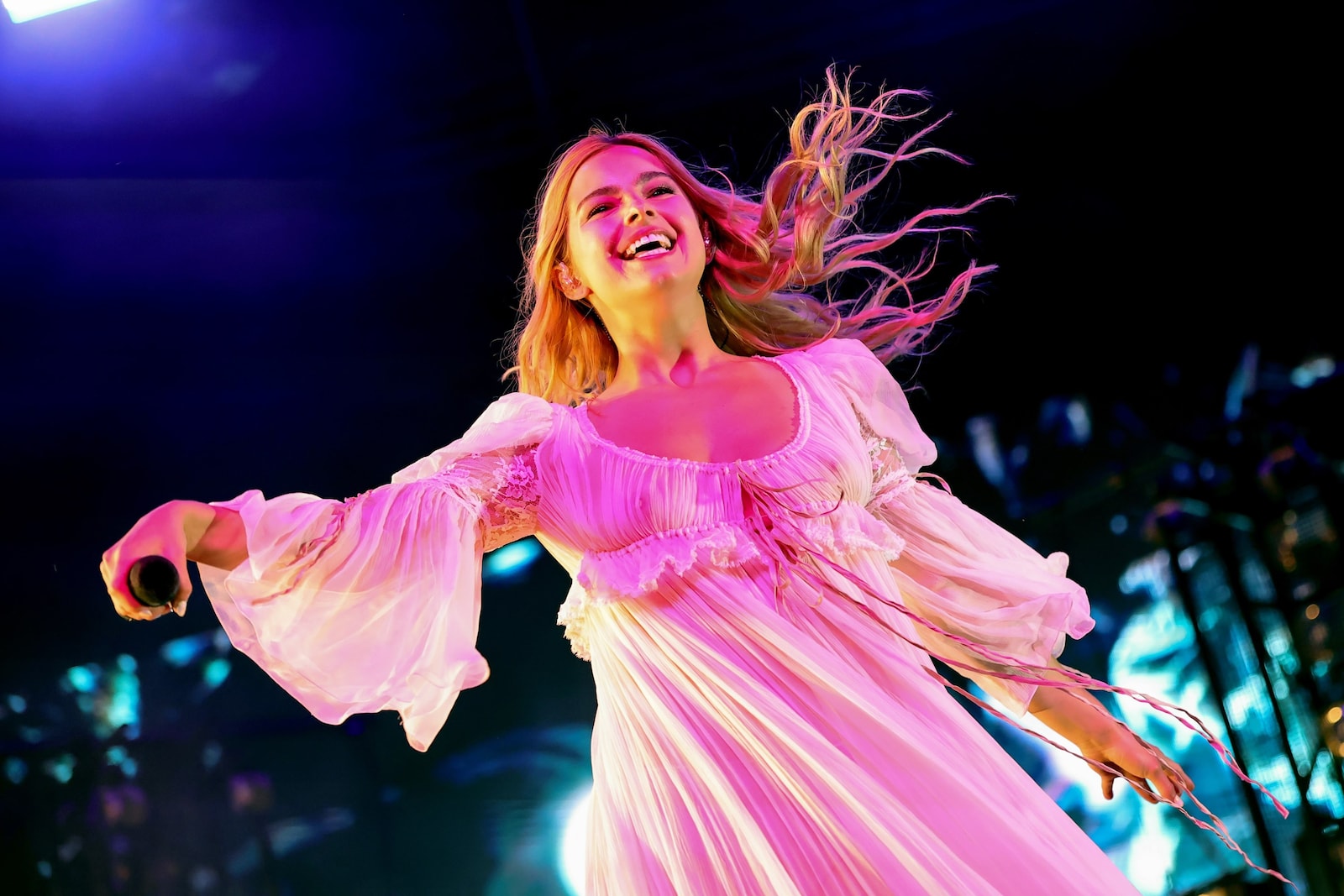
Rae is now, on her own, without any brand to colour her, right there on the edge of culture, like a siren on the bow of a boat. And with her, she’s seemingly introducing a new spiritual style.
The spiritual specification is harder to assign than its predecessor. There are no rosaries or overt fashionings of Biblical scripture. The look-meaning dialogue is less solid, as if it emerged from the mist the siren leads us through, knowing the way because she — in this case Rae — once belonged to it. The vibration is intuitive and soulful, dressed up in goods that could only belong to this world (like Rae revealing her album release date on the back of a pair of Victoria’s Secret knickers at Coachella). It’s full of life, an ancient flutter, a rainbow arching back to your essential being.
On the back cover of her self-titled album, a technicolour tracklist spirals around Rae in funky letters. This geometry isn’t quite sacred, but it’s close enough to the Fibonacci sequence that it made me think of the cover of Star, the album released by 21-year-old rapper 2hollis in April. Star’s artwork is a rendering of Metatron’s Cube, a figure of sacred geometry named for a powerful angel in sacred Jewish texts like the Talmud and the Kabbalah. Metatron’s Cube is a New Age interpretation of the archangel’s significance — a representation of his connection to divine creation and knowledge.
Though Rae and 2hollis have been famous and making music for a while, these albums are technically debuts. Both records are largely concerned with what it feels like to enter celebrity; wanting stardom, knowing you were destined for it, and what it’s like to get it. They create a picture of fame, worldly but inherently tied to transcendence, using a texture that is both declarative and spiritual, with lyrics like, “The world is my oyster, baby come touch the pearl,” (Rae’s second single Aquamarine), “You are now witness to something great … a miracle” (lash, the opener on Star), and references to angel numbers across both bodies of work (11:11 for Rae and 2222 for 2hollis). As part of her sparkling pre-release press run, Rae appeared on the cover of Elle under the headline “Addison Rae manifested this cover.”
After listening to Star and watching Rae’s album roll-out, I started calling this genre, linked by thematic rather than sonic similarities, ‘manifestation pop’. The language used, particularly by Rae, is nearly identical to the gospel of manifestation and affirmation that’s taken hold of pop culture under the directive of Gen Z and millennials. Money Is Everything ends with Rae crying out, “Money loves me! I’m the richest girl in the world!” while she sings that “every good thing comes my way” on a later track. These are lines straight from manifestation rituals, popularised on TikTok, which instruct the user to affirm an abundant relationship with success, financial and otherwise, through their words.
I started to think more about precedents for this mindset. The telegenic Texan mega-pastor Joel Osteen is famous for preaching the prosperity gospel, which asserts that God rewards the faithful with material success. It’s a controversial teaching that Osteen has stepped away from in recent years. But his sermons still carry its message, as he encourages his congregation to work towards “unlocking their blessings” and “change their worlds by changing their words.”
I don’t think that Rae’s manifestation practice is drawn from Osteen’s teachings or that it can be assessed the same way. But the idea of a country girl manifesting money, success and all her wildest dreams — while spreading love and light along the way — sounds like an anecdote plucked right out of one of Osteen’s Sunday sermons. Success stories like these are ever-powerful in a society that emphasises personal responsibility over institutional systems or community support as the key to wellbeing and accomplishment.
When I wrote about the rise of Christian aesthetics in 2021, I proposed that this style was a response to the backlash against culture appropriation in the 2010s. The idea went: it was no longer considered acceptable to jack minority swag to look cool (think: box braids on the Kardashians, Native American headdresses at music festivals), so those looking to differentiate themselves had to mine sources that remained exotic without being problematic (here that meant a Western religion that was familiar but not exactly cool or relevant). That’s not the case anymore. At an underground alternative show in London last month, I met several girls under the age of 25 wearing bindis for purely decorative purposes.
There’s an ambiguously Eastern flavour to the world of manifestation pop. 2hollis’ mum is a reiki healer and Rae’s philosophy feels a little Buddhist, despite its unabashed pursuit of glamour and earthly splendour. “What you think you become,” said the Buddha. “There’s no mystery, I’m gonna make it, gonna go down in history,” answered Rae.
Looking back, I think a lot of people were drawn to Christianity, whether at the surface level or deeper, because it has rules — rules that are bigger than the movable ones that governed culture under social justice at the time.
Social justice isn’t governing anymore, and so culture is recalibrating with its exit. People still want God, but doctrine is no longer a main, if latent, draw — it’s the love and openness inside of all of us that God, or the universe (Rae uses both terms), is. It helps that this specific spiritual outlook is also compatible with pop-consciousness’ belief that our minds control our destinies (and thus our achievement of material ambitions, whether it be transforming from a TikToker who isn’t taken seriously to a popstar who is, or just being hot and well-married).
In Zen and The Birds of Appetite, a collection of essays on the relationship between Zen Buddhism and Christianity, Thomas Merton writes that “openness is not something to be acquired, but a radical gift that has been lost and must be recovered.” That’s what people want from pop stars and spiritual frameworks right now — to be shown how to feel free, to connect with the part of themselves that is of the mist. Rae says so herself on her album’s opening track: “Feel so free, it’s my religion.”
