
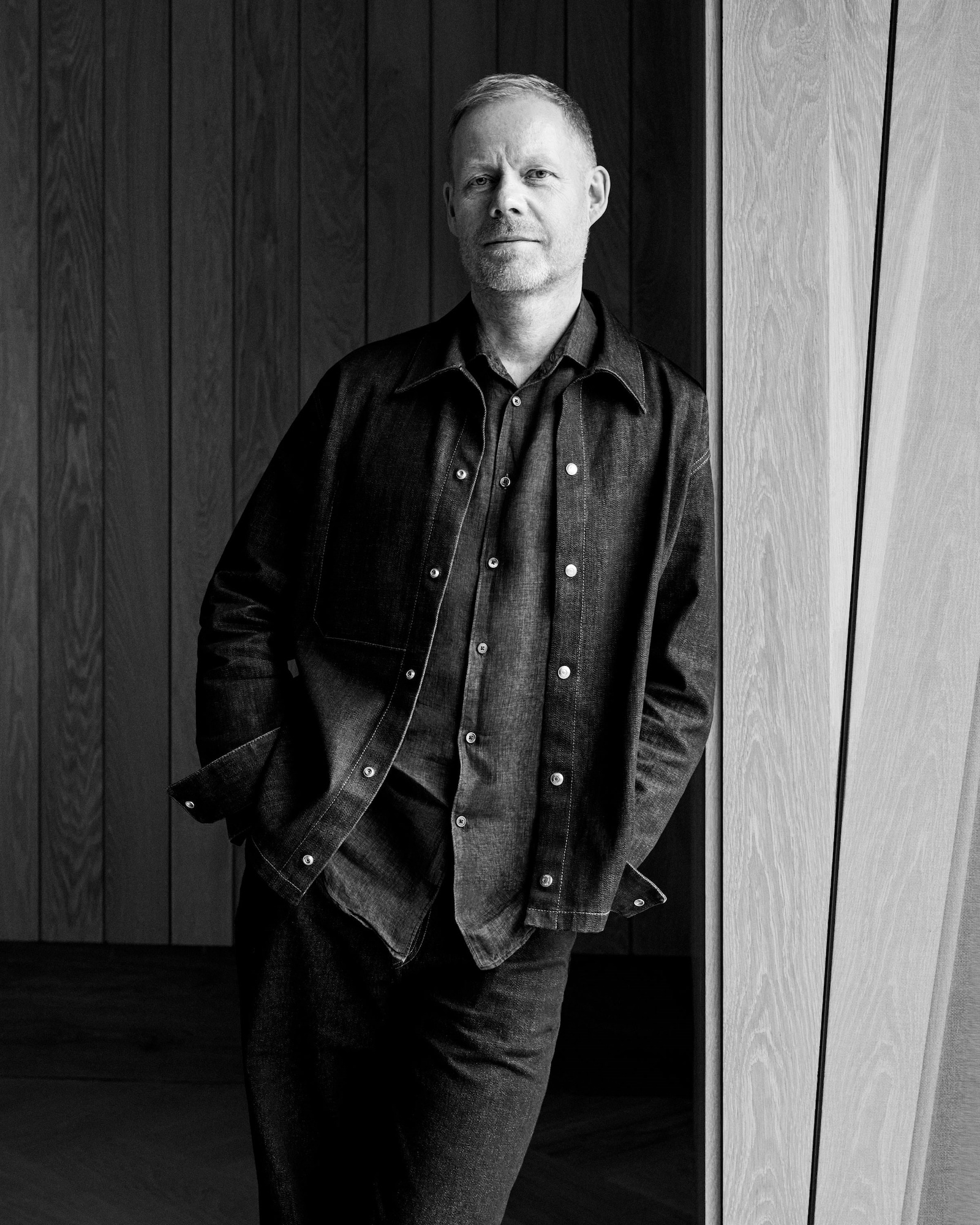
Max Richter dials in from his Oxford studio. Behind him are shelves and shelves of books, before them stands a grand piano, centre stage. “I see music as a way of making enquiries into the world,” says Richter. He speaks with a rhythm not dissimilar to that of his music – thoughtful, eloquent, transcendental. “Like making a map, in a way.”
The German-British composer grew up in the kind of household where artists like Bach and Schubert played from the record player around the clock. “Traditionally German,” he says. Richter recalls hearing Bach’s Brandenburg Concerto as a child and being intoxicated by its language, its grammar. A lifelong relationship with the piano began. As he found that playing the instrument could function “like a diary”, it became his way of making sense of the world.
Classical yet often infused with electronica, Richter’s oeuvre – which spans film, television, ballet, fashion – is genre-defying. He has scored films including The Leftovers (2014), Mary Queen of Scots (2018) and Ad Astra (2019), and collaborated with Kim Jones for the Dior Men’s Fall 2023 show, a partnership which saw him perform in front of the Giza Pyramids. His versatility knows no bounds.
This September marks a decade since the release of his infamous concept album, Sleep, an eight-and-a-half hour long enquiry into how sound and the sleeping mind interact, co-conceived with his creative partner Yulia Mahr and informed by American neuroscientist David Eagleman.
Richter will celebrate this milestone anniversary with the release of a new album – Sleep Circle, a 90-minute hypnagogic trip, out September 5 – as well as his largest all-night performance of Sleep yet, taking place at London’s Alexandra Palace on September 5 and 6. Here, we speak to Richter about his new album, the grammar of music and how it is his way of making sense of the world.
Rose Dodd: Let’s talk about the new album.
Max Richter: Sleep Circle is a 90-minute recording of material I wrote for concert performances which we played across the world in 2023. It uses material which is more active, a bit more front brain, rather than immersive and unconscious, offering another trip through the sleep landscape.
RD: This more ‘active’ material and iteration of Sleep, does that mimic the dream-state REM sleep as opposed to deeper non-REM sleep?
MR: You could think of it in that way. It is more hallucinogenic, dreamlike. But sleep is a wide open space, and while there is a neuroscientific basis to some of the material, I try not to prescribe too much as to how people should experience, how they should listen to it or even how they sleep through it.
RD: This is an ongoing work continuing from your concept album Sleep. Where does this interest in sleep stem from? Do you sleep well yourself?
MR: I do. It really started in around 2011-2012 and it was the time when people really started live streaming gigs. I’d been touring all over the world and my partner, Yulia, at home, would tune in at crazy hours, morning and night, across different time zones. We spoke a lot about how listening to music in that sort of half awake-half asleep state is very impactful and invokes a direct emotional impression. This was also the time when there was a sort of explosion of digital data and we had access to it from our pockets. I was also thinking about large scale artworks – big novels, films, visual arts – and how they become almost alternate realities. These things fed into the idea of this big piece, an environment for overnight.
RD: A performance that is the length of an entire night’s sleep, and a good one at that, truly is a large scale artwork. Can we go back to when you first started playing music?
MR: My early experiences of music made quite an impression on me. I’m not from a musical family, but my parents had records and they’d play them, you know, classical music that you would hear in a traditional German household – Bach, Schubert. I remember hearing Bach’s Brandenburg Concerto, I must have been three years old, and I was floored by these beautiful melodies but I also perhaps had this intuition that there was something else going on behind these sounds that made them work together, a grammar.
RD: Grammar is an interesting term.
MR: I was intoxicated by the idea of trying to uncover it. So that drew me towards music – later I started having piano lessons, which I gave up at around seven years old until I was in my teens because my teacher would hit me with a ruler if I made a mistake. I was still playing during the interim though, then I went on to college and to university.
RD: Do you think music is a language one can learn, or is it innate?
MR: Some people definitely have a natural musical sympathy, an intelligence, but everyone has the potential to be around or involved with music in some way. Humans are deeply musical creatures.
“Humans are deeply musical creatures” – Max Richter
RD: You’ve written scores for and had music featured in a number of films and television series, working with directors like Denis Villeneuve and Martin Scorsese. How do you translate written or spoken word from scripts or conversations into your music?
MR: Writing music for film is a different discipline from records or concert pieces because in a film, really, what the music is doing is the thing that other mediums can’t. It inhabits a space where words, lighting, editing, aren’t enough or are too much. Writing for those moments is a puzzle-solving exercise, an experimental process. It’s working with the director and the editor to figure out how to make music feel intrinsic and inevitable to that world. Most of my life is me sitting in a room on my own writing or playing music, but I really enjoy working with people.
RD: Ad Astra and Black Mirror are quite Sci-fi, dystopian and futuristic, right? Then you have Jóhann Jóhannsson ,who scored Arrival which features a song of yours, Hans Zimmer on Dune and Interstellar. When did classical music become so apt for these futuristic worlds?
MR: I see music as a way of making enquiries into the world, like making a map, in a way. And these stories are about questions and possibilities, and they invite that questioning music in nicely.
RD: Is music your way of making sense of the world?
MR: I guess this applies to most if not all creative practices, but music, for me, functions like a diary, a script of the things you’re going through. It’s a way of processing your own experiences. If I’m ever feeling down, I’ll just play some Schubert or something and I know I’ll feel better. Music is like talking. It’s a way of talking to one another in a beautifully direct way. Something written 500 years ago still speaks to us. This is a really valuable quality that music has.
RD: What are the differences between being a composer today or one in the era of Mozart? Aside from technology.
MR: Over the centuries, music cultures have become quite siloed. There was always folk music, and classic, but things used to be a bit more connected. There weren’t all these isms and genres and silos and boundaries. That really is something that happened during the 20th century. I guess it’s the product of modernism. I think this is fading away though. With the advent of streaming, everyone’s listening to everything – and there’s a lot more tolerance, an openness even, for things that cross boundaries. I’m super happy about that.
“It’s like being a cook, your dishes will have a kind of flavouring that makes them taste like yours. That’s the same with music” – Max Richter
RD: What is your process when it comes to composition?
MR: There is no single way that I go about things. I write a lot on paper. It’s fast. I also work with a computer, synthesisers, whatever tools I have at my disposal – an iPhone.
RD: Do you have any musical ticks – a modulation, a motif?
MR: I’ve probably got some fingerprints, some habitual ways of thinking. It’s like being a cook, your dishes will have a kind of flavouring that makes them taste like yours. That’s the same with music.
RD: When is the work finished?
MR: With some pieces, you basically write them down and they’re done. Others, you’re wrestling with them for weeks and weeks. The writing process itself for me is about trying to discover what the piece wants to be, trying to discover its own inevitability, the feeling. It’s very experimental.
RD: What is one piece of music that always makes you feel better?
MR: Stravinsky’s Firebird. Great tunes.
Max Richter will perform Sleep at Alexander Palace in London on September 5 and 6. His new album, Sleep Circle, is released on September 5.
